Engineering-led security · Open-access technical book
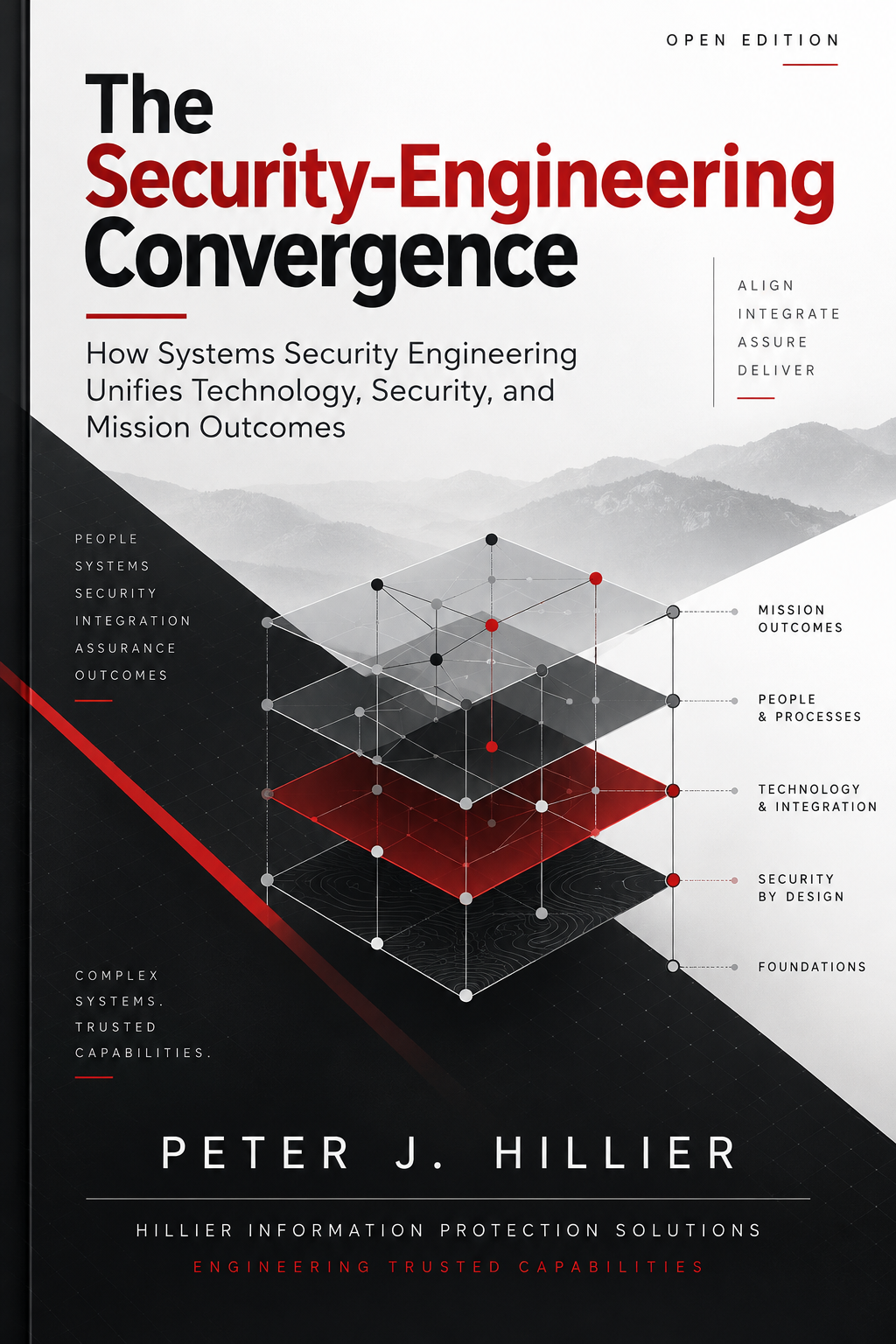
The Security-Engineering Convergence
How Systems Security Engineering Unifies Technology, Security, and Mission Outcomes
Peter J. Hillier, CD, CISSP
Edition 1.1 · Current release · Free and open access
A practical technical reference for the people who specify, engineer, acquire, assess, operate and lead complex systems.
The central argument
Security must be engineered into the capability
A system can satisfy its security controls and still fail its mission when assumptions about interfaces, authority, dependencies or operating conditions prove wrong.
The Security-Engineering Convergence examines Systems Security Engineering (SSE) as the security specialty integrated within systems engineering. It does not present SSE as a replacement for systems engineering, cybersecurity operations, risk management or compliance. Instead, it shows how those contributions can connect to the engineering work that shapes system behaviour across its life cycle.
The book follows a practical line of reasoning: establish the needed mission outcome, characterize the system and its context, investigate adversity and loss, develop requirements, choose and assess architectures, evaluate evidence, and maintain the resulting basis for trust through acquisition, operation, change and retirement.
Engineering confidence is earned through clear claims, justified design decisions and evidence whose limitations are understood.
Who the book is for
Systems engineers
Integrate protection needs, security-specific analyses and assurance into established engineering decisions and artefacts.
Cybersecurity practitioners
Connect controls, threat analysis, assessments and operations to requirements, architecture, verification and mission consequence.
Acquisition and leadership
Understand what to demand from suppliers, what evidence means, and where decision authority and residual uncertainty remain.
Inside the manuscript
Seven parts. Twenty-eight chapters. One engineering argument.
The material progresses from shared foundations through requirements, architecture, implementation, assurance, operational sustainment and emerging system challenges. This chapter list reflects the current published Edition 1.1.
PART IEngineering foundations
The relationship among mission capability, the system boundary, controls, risk and integrated engineering responsibilities.
- 01Security as an engineering responsibility
- 02Systems, boundaries and operational context
- 03Compliance, controls, risk and engineering
- 04One life cycle, integrated responsibilities
PART IIFrom needs to evidence
Develop protection needs, analyze adversity, allocate requirements and plan the evidence required to justify claims.
- 05Mission, stakeholders, assets and protection needs
- 06Adversity, threats and loss scenarios
- 07Requirements, policy, constraints and allocation
- 08Planning assurance and technical evaluation
PART IIIArchitecture, interfaces and resilience
Reason about architecture, composed systems, models, design alternatives and controlled degradation.
- 09Trustworthy secure architecture and design
- 10Interfaces, dependencies and composition
- 11System analysis, MBSE and trade studies
- 12Cyber resilience and controlled degradation
PART IVRealization, integration and evaluation
Connect production and enabling systems to integration, verification, validation, human use and transition.
- 13Implementation, production and enabling systems
- 14Integration and emergent behaviour
- 15Verification and validation
- 16Human-system design and transition readiness
PART VAcquisition and justified decisions
Specify supplier obligations, examine assurance arguments and support accountable acceptance decisions.
- 17Acquisition and contractual engineering
- 18Supplier contributions and supply-chain assurance
- 19Evidence, assurance cases and technical challenge
- 20Risk decisions, acceptance and authorization
PART VIOperations and life-cycle change
Carry the engineering baseline into operation, maintenance, cloud dependencies, legacy systems and retirement.
- 21Operations, response and continuing support
- 22Configuration, change, maintenance and drift
- 23Legacy, COTS and cloud-dependent systems
- 24Retirement, transfer and disposal
PART VIIManagement and emerging complexity
Integrate technical management, competence, systems-of-systems and human–AI engineering.
- 25Technical management and engineering control
- 26Organizational capability, integration and competence
- 27Systems-of-systems and critical infrastructure
- 28AI, autonomy and human–AI engineering
Technical appendices
Worked and bounded cases, modelling orientation, information-flow analysis, resilience under supplier compromise, and reusable worksheets complement the chapters.
- Appendix A — MBSE languages, tools and exchange
- Appendix B — Worked-case and record guide
- Appendix C — Completing a bounded engineering case
- Appendix D — A cyber-physical inspection vehicle
- Appendix E — Protecting information flow without losing the support function
- Appendix F — Resilience when a trusted source becomes suspect
- Appendix G — Practitioner worksheets
What's new
Edition 1.1 builds on the first edition
Edition 1.1 adds engineering-focused treatment of privacy and adaptation under adverse conditions, improves explanation around the technical figures, and includes standards-oriented crosswalks in the companion resources.
The earlier Edition 1.0 remains available for readers using or citing that version. The editions have separate version-specific Zenodo DOIs.
What makes it practical
Methods, examples and decision records
The book uses scenarios and case records to demonstrate engineering reasoning rather than merely describe successful outcomes. It distinguishes hypothetical case assumptions, analytical models, executed teaching-code tests, technical evidence and the decisions that evidence may—or may not—support.
Traceable engineering
Mission needs, losses, requirements, architectures, evaluations and decisions remain connected.
Multiple system contexts
Worked material includes administrative authority, cyber-physical motion, information flow and trusted-source compromise.
Reusable practitioner tools
Worksheets support documenting protection needs, allocation, architectural trade-offs, evidence applicability and change impact.
Illustrative case material must not be mistaken for evidence that a corresponding real-world operational system has been tested, authorized or validated.
Open-access resources
Read and download the book
Download the current Edition 1.1 and companion materials. The paginated PDF is the authoritative reference edition; the reflowable EPUB is an alternative for compatible reading applications.
Technical book (PDF)
Complete paginated reference with chapters, figures, tables and appendices.
Download the PDF ↗
EPUB edition
Reflowable reading version. Complex technical layouts may be more reliable in the PDF.
Download EPUB ↗
Engineering companion
Teaching model, worked examples, diagrams, worksheets and the new standards crosswalks.
Download companion ZIP ↗
Check the release notes and SHA-256 checksums for edition changes and file integrity. No illustrative example constitutes verification of an actual deployed system.
About the author
Peter J. Hillier, CD, CISSP
Peter J. Hillier is a Canadian cybersecurity consultant, Systems Security Engineering practitioner, and founder of Hillier Information Protection Solutions Inc.
With more than four decades of experience spanning military intelligence, national defence, enterprise cybersecurity, and security governance, Peter brings an operational and systems-level perspective to the engineering of trustworthy capabilities.
A 20-year veteran of the Canadian Armed Forces, his subsequent career has included enterprise Chief Information Security Officer roles, cybersecurity incident-response leadership, security architecture, and advisory work supporting complex defence systems and major naval acquisition programmes.
His more recent work focuses on Systems Security Engineering, cyber resilience, supply-chain assurance, secure procurement, and integrating security considerations into the engineering and sustainment of mission-critical capabilities.
A published practitioner, educator, and contributor to international security-engineering initiatives, Peter advocates moving beyond compliance as the primary measure of security toward disciplined engineering, meaningful evidence, and accountable decisions.
Through his writing and professional work, he seeks to make engineering-led security more accessible to the engineers, cybersecurity practitioners, acquisition professionals, and leaders responsible for the systems upon which modern institutions depend.
Author's LinkedIn profile ↗
Publication and reuse
Free to read. Intended for responsible reuse.
Except where otherwise expressly indicated, material for which the author holds the necessary rights is licensed under Creative Commons Attribution 4.0 International (CC BY 4.0) ↗. Separately identified third-party materials retain their applicable terms.
Download earlier Edition 1.0
For reproducibility and citations, the original published edition remains available: GitHub v1.0.0 downloads ↗ and Zenodo Edition 1.0 ↗.
Citation, versions and corrections
Each published edition has its own Zenodo DOI. Earlier files remain available rather than being silently replaced. Cite the version you actually used.
This work is independently authored. It should not be mistaken for an official defence, government or standards-body publication.